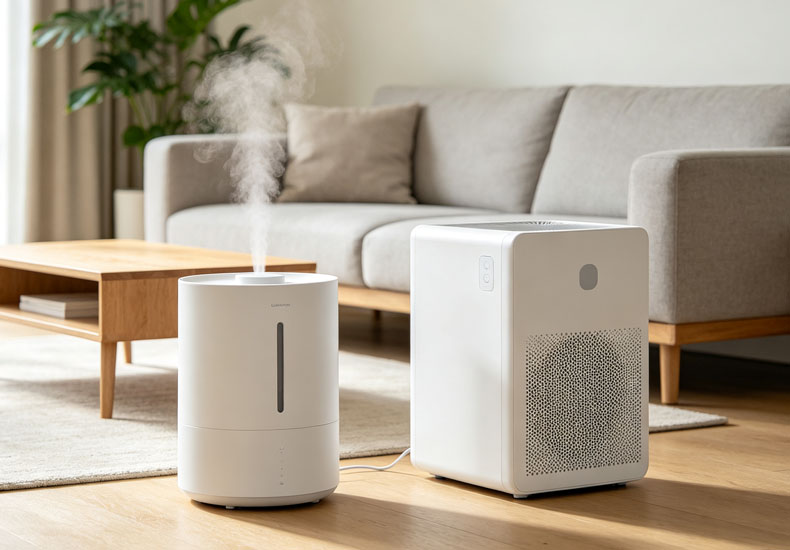
Every heating season brings the same annoyances: tight skin, peeling lips, and a dry scratchy throat in the morning. Touch a light switch and you may even feel a small static shock. The air is simply too dry. These discomforts are real, so a humidifier has become a standard bedroom fixture.
But open any e-commerce page and the product names spin around: ultrasonic, evaporative, cool mist, mist-free, warm evaporation. The two easiest to mix up are the “mist” type and the “mist-free” type. Their humidification principles are completely different, and so is their effect on indoor air. Clear up that difference first, and choosing for the bedroom becomes much simpler.
1. How evaporative and ultrasonic humidifiers work
The most common mist-type humidifier is the ultrasonic model. Its principle can be simplified to “shattering.” Below the water surface sits a high-frequency vibrating ceramic plate. It vibrates millions of times per second, breaking the water into extremely fine mist that is then blown out through the air outlet. The white mist you see is really countless tiny water droplets, from a few microns to tens of microns across.
Here is the key detail: an ultrasonic humidifier does not release only “pure water” into the air. Whatever is dissolved in the water comes out with the mist. That includes minerals, microorganisms, and any essential oil or disinfectant you add. In short, whatever impurities are in the water end up in your air.
The mist-free type (the evaporative humidifier) takes a different path: “drying.” Inside it sits an absorbent wick or disk. A fan blows indoor air across this wet wick, and the water evaporates naturally into the air as water vapor. You see no white mist, because the water leaves the wick as a gas. More importantly, the wick traps most minerals, particles, and microorganisms inside the machine. They do not enter the room with the vapor.
In short, the mist type atomizes and sprays a whole bottle of water. The mist-free type releases only water vapor. This underlying difference is exactly why the two types affect indoor air quality so differently.
2. The risks of the mist type: more than just “white dust”
Many ultrasonic-humidifier users have seen this before. A thin layer of white powder soon settles on the furniture and floor near the machine. It builds up again a day after wiping. This is the trace of calcium and magnesium minerals from tap water. They were atomized, then deposited when the water evaporated. The key point: what lands on the table you can see. What floats in the air, you may not notice.
A 2020 experiment by Park and colleagues in South Korea tested both types side by side. Each humidifier was placed in a sealed chamber of about 11 square meters (3.8 × 2.95 × 2.8 m, about 31 cubic meters) and run with tap water of different hardness. After the ultrasonic humidifier ran, indoor PM2.5 shot up from background levels to 16–350 μg/m³, depending on water hardness. The evaporative humidifier, under the same conditions, added almost no PM2.5 regardless of water quality.
That number matters. A reading of 350 μg/m³ far exceeds the 24-hour PM2.5 limit in China’s ambient air quality standard. In other words, you turned on the humidifier to feel more comfortable. But the particle concentration in your room may have become higher than on a hazy day.
What is more worrying is how fine these sprayed mineral particles are. The median particle size can be a little over one hundred nanometers, small enough to reach deep into the lungs. A study by Yao and colleagues at Virginia Tech, published in Water Research X, used the MPPD model to simulate what happens after inhalation. The findings are worth reading carefully.
After adjusting for body weight, the particle mass deposited in a child’s lungs was about 3.5 times that of an adult: 9.8 versus 2.8 μg per kg of body weight. The absolute total was actually lower — 58.8 μg in the 3-month-old model versus 199.6 μg in the adult. But on a per-kilogram basis, the child’s inhaled burden is clearly heavier.
The reason is not complicated. Children breathe faster, have narrower airways, and have a larger lung-surface-area-to-body-weight ratio. At the same air concentration, they inhale and deposit more particles overall.
Another study by the same team, published in Environment International, took a different route. It changed the water from deionized water all the way to high-hardness tap water, then observed how the particles spread through the room and how much people actually inhaled. The harder the water, the coarser and more concentrated the sprayed particles became. This points the same way as the study above: what really decides how much “white powder” you get is how many minerals are dissolved in the water.
So for an adult, an ultrasonic humidifier in the bedroom may be “just a little white powder.” But for a child in the same room, the effect can be completely different.
Besides minerals, microorganisms are also “passengers” of the ultrasonic humidifier. In a 2021 study by Lau and colleagues at the University of Alberta in Canada, one ultrasonic humidifier was run in a real home. It drove whole-house, real-time PM2.5 into the hundreds of micrograms per cubic meter, with the effect covering the entire home. Ion chromatography also found large amounts of sulfate in the particles. That means the humidifier itself is a previously unrecognized indoor source of sulfate. Indoor pollution has more sources than we imagined.
A 2017 evidence brief from Public Health Ontario reached a similar conclusion. Evaporative humidifiers do not generate aerosols, so they carry a low risk of microbial spread. Ultrasonic and impeller humidifiers, in contrast, produce aerosols that may contain pathogens. Their disease-transmission risk is significantly higher.
The U.S. CDC adds a precondition in its environmental infection-control guidance. Healthcare facilities should avoid cool-mist (ultrasonic / impeller) humidifiers that produce aerosols, unless they can be disinfected to a high level every day and use only sterile water. The U.S. Veterans Health Administration goes further: it directly bans ultrasonic humidifiers and allows only steam humidification.
Finally, there is one extreme risk that must be guarded against: humidifier disinfectants. The unexplained lung disease outbreak in South Korea in 2011 was later confirmed to be directly linked to disinfectants such as PHMG used in humidifiers. Case-control studies showed a 47-fold higher risk of lung disease among humidifier-disinfectant users (OR = 47.3, 95% CI 6.1–369.7). The Korean government subsequently pulled humidifier disinfectants from the market entirely.
The warning for everyone is simple. No matter which humidifier you buy, never add any disinfectant, essential oil, vinegar, or other “additive” to the tank.
3. Why the mist-free type is safer — and its trade-offs
The benefit of the mist-free (evaporative) humidifier follows from its principle. Water leaves the machine as vapor, so most minerals, particles, and microorganisms stay on the wick. They are not actively blown into the room. The Park et al. experiment mentioned above already verified this: the evaporative type does not increase indoor PM2.5.
In terms of energy use, the two types differ little. China’s GB/T 23332-2018 grades humidification efficiency. The Grade A threshold for evaporative and hybrid types is ≥14.5 mL/(h·W). For ultrasonic it is ≥13.5 mL/(h·W). The gap is only about 7%. So “more energy-efficient” is not really a reason to choose the mist-free type.
What truly sets them apart is the earlier point: the ultrasonic type sprays everything in the water into the air. The evaporative type lets only water vapor through.
But the mist-free type is not a perfect solution either. It has several obvious shortcomings.
First, noise. The evaporative type relies on a fan blowing across the wet wick. That fan is louder than the ultrasonic type’s silent ceramic plate, which may bother light sleepers.
Second, the wick needs regular replacement. A wick soaked in water for long periods is itself a breeding ground for microorganisms. If it is not replaced or cleaned on time, the inside of the machine may become dirtier than an ultrasonic tank.
Third, humidification is relatively slow. The ultrasonic type sprays directly, while the evaporative type dries slowly. At the same power, the ultrasonic type moves the humidity gauge faster. But if the bedroom is not large and its door and windows seal normally, the evaporative type’s sustained humidification is usually enough.
On balance, in the bedroom, safety generally outranks speed. After all, you spend seven or eight hours a day — or more — in that room.
4. The humidifier itself is still worth using: 40–60% is not an arbitrary number
All this talk about the risks of the mist type is not meant to scare you into quitting humidifiers. On the contrary, over-dry indoor air in winter is itself a health hazard.
A 2024 review by Wolkoff at Denmark’s National Research Centre for the Working Environment reached a clear conclusion. Published in the International Journal of Hygiene and Environmental Health, it summed up recent studies on influenza and COVID-19. Low indoor humidity (dry air) increases acute eye and respiratory symptoms. It weakens airway mucociliary clearance and lowers innate immune defense. It also increases the virus-laden aerosol exhaled by infected people. The review defines 40–60% relative humidity as the optimal range for reducing respiratory infection risk, calling it the “Goldilocks zone.”
The Chinese CDC’s 2023 guidance gives similar advice: the most suitable humidity is 30–60%. Above 65%, the risk of pneumonia and bronchitis may increase. Taken together, the value of a humidifier is not “having one is enough.” It is about keeping the humidity steady within that range.
So the question is not whether to humidify, but how to humidify. The mist type humidifies fast, but it spreads minerals and microorganisms into the air. The mist-free type is a bit slower and slightly noisier, but it releases only water vapor and brings in no impurities.
For the bedroom, that difference matters. You stay there long, breathe close, and the air circulates relatively little. In that space, the mist-free type has a much wider safety margin.
5. Choosing and using one: a few practical tips
If you plan to buy a humidifier for the bedroom, a few practical tips matter more than comparing parameter rankings.
First, prefer the evaporative (mist-free) type. All the principles and data above boil down to this one point. If you already own an ultrasonic model, it is not unusable. But use purified or distilled water, not tap water. And never add any disinfectant, essential oil, or vinegar to the tank.
Second, change the water daily and clean it regularly. The Chinese CDC recommends changing the water every day and cleaning thoroughly every two weeks. If you leave water standing, a biofilm forms on the inner tank wall. Bacteria multiply in it, then get shattered and sprayed out by the ultrasonic plate. You would be building yourself a “bacteria sprayer.”
Third, humidity is not “the higher the better.” Put an inexpensive thermometer-hygrometer by the bed. When humidity reaches about 50%, lower the setting or turn the humidifier off. Above 60%, it not only becomes less comfortable, but also creates good conditions for mold and dust mites to breed.
Fourth, placement matters. Keep the machine about one meter away from heat sources, appliances, and furniture. Do not point it directly at people. And do not place it on a carpet — a damp carpet breeds bacteria easily.
6. The humidification wick matters as much as the humidifier itself
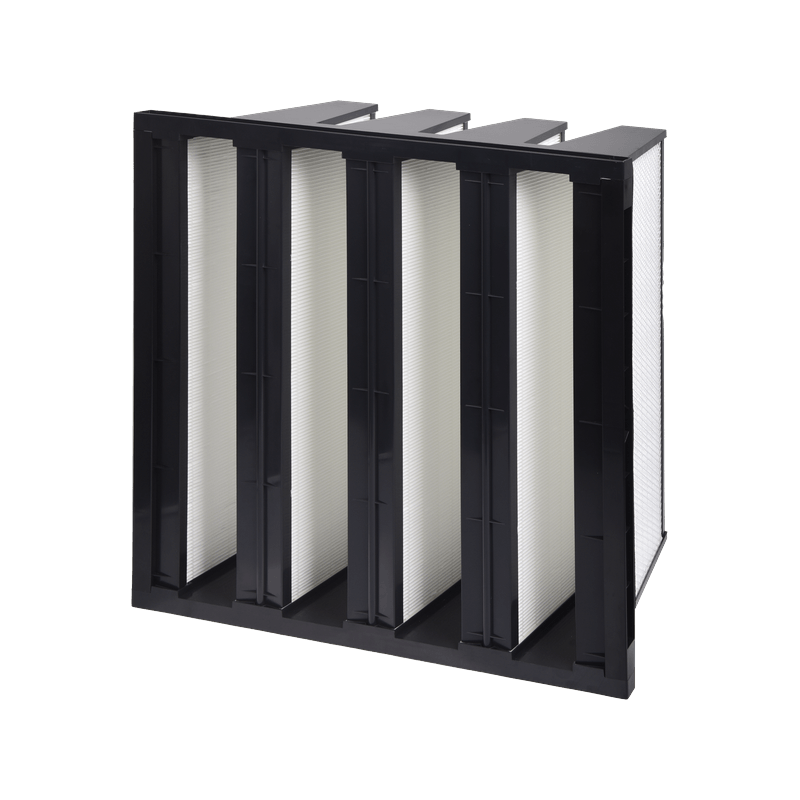
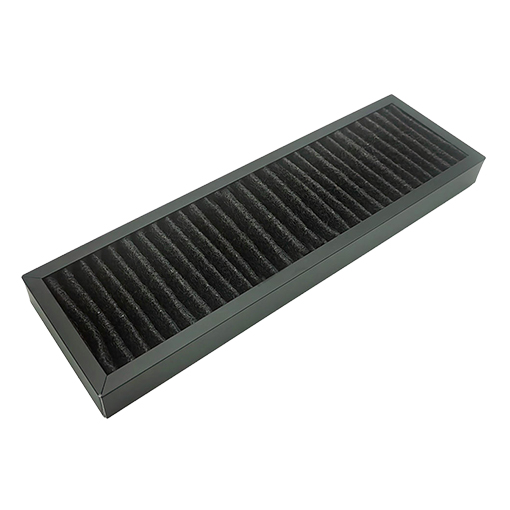
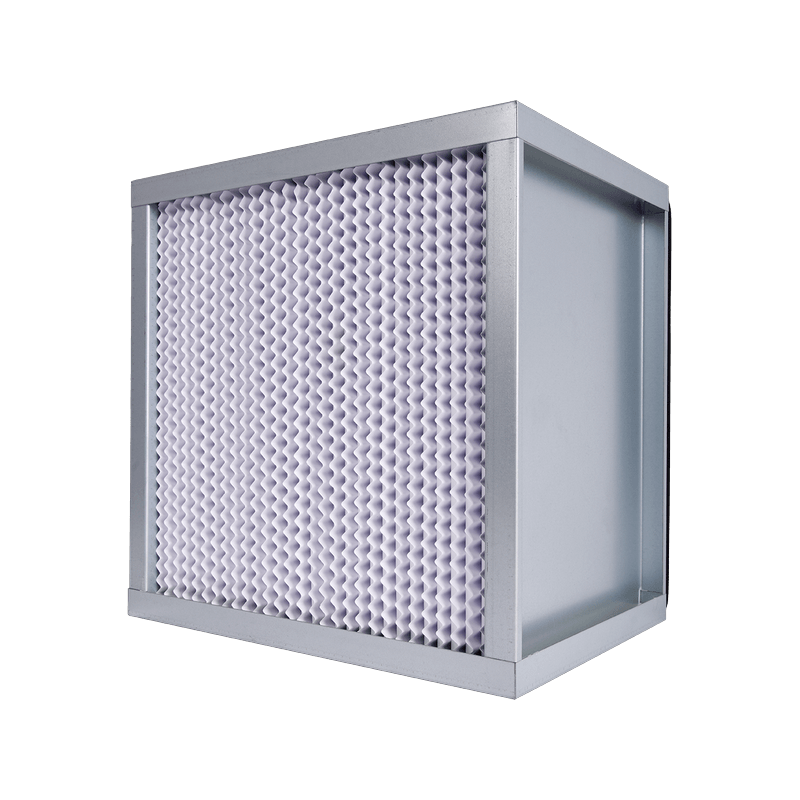
The evaporative (mist-free) humidifier is not complicated in structure. Its core is a single humidification wick. Water seeps through the wick, the fan blows air across it, and water vapor then enters the air. The quality of the wick directly decides three things: how fast humidification works, whether impurities are carried out, and how often the wick needs replacing.
A wick soaked in water for long periods tends to yellow, harden, and grow bacteria. Once scale forms on its surface or microorganisms breed on it, humidification efficiency drops noticeably. The air it blows out may even carry an odor. So do not focus only on the humidifier unit. The wick is the core consumable, and it needs regular replacement.
Conclusion
Back to the original question: for the bedroom, should you choose a mist-free or a mist humidifier? If you want fast humidification, an ultrasonic humidifier can raise the humidity in minutes. If you value steadiness more, an evaporative humidifier is slightly slower and a bit noisier. But it releases no extra impurities into the air.
The bedroom is where you stay longest each day and breathe closest to the air. In that dimension, steadiness matters more than speed. Of course, if you already bought an ultrasonic model, there is no need to replace it. Use purified water, add nothing to it, and change and clean it frequently. The risk can be controlled.
Do not be swayed by “humidify fast” marketing. A low-risk choice that suits the bedroom environment is the one that truly improves comfort.